2026 Masterclass on AI Brand & Sentiment Optimization
By Craig Lawson, Founder & CEO of ClickReady Marketing. Craig has led SEO and Google Ads campaigns for service businesses since 2010 and heads one of the top 3% of Google Partner agencies nationwide.
As the old adage goes, "The best time to plant a tree was 20 years ago; the second best time is now." In the landscape of AI, that "tree" represents your brand’s authority. But in 2026, the soil has fundamentally changed. As a leading digital marketing agency, we’ve seen that we are no longer just optimizing for a static Google search bar; we are optimizing for dynamic AI agents—Large Language Models (LLMs) like ChatGPT, Gemini, and Perplexity that act as digital concierges for users.
If your business feels invisible to these AI bots, you’re likely missing small things that can make a big difference. This masterclass summary outlines exactly how to bridge that gap, perform your own AI audit, and reclaim your digital presence.
The Shift: Why Traditional SEO Isn't Enough
For years, the goal was simple: rank #1 on a search engine results page (SERP). Today, the goal is different. You need to be the answer, not just a link. When a user asks an AI, "Who is the best log home repair expert in Atlanta?", the AI doesn't give ten blue links. It gives a recommendation.
This shift requires a new kind of audit—one that focuses on Sentiment, Brand Authority, and Recommendation Logic.
What is the Recency Gap?
A "Recency Gap" occurs when an established business hasn't generated new digital "heat" or machine-readable signals in the last 12–24 months. AI models prioritize current data. If your last major press mention, review spike, or schema update was three years ago, the AI may deprioritize you in favor of a newer competitor—even if your service is objectively superior.
Phase 1: The Trust Foundation & "Legacy Signals"
AI doesn't just scan for keywords; it looks for "Legacy Signals." It wants to verify that you aren't a "pop-up" shop. If you have been in business for decades, you need to provide the digital receipts in a format the machine understands.
Proving Your Standing
For every claim you make on your site—whether it's "Best Pizza in Buckhead" or "Expert Log Home Repair"—the AI needs to see a corresponding proof point. This includes:
- License Numbers: Don't hide them in a footer link. Put them near your service descriptions.
- Insurance Certifications: Explicitly state your coverage.
- Industry Memberships: Badges matter, but the text describing them matters more.
To truly "close the loop," AI systems actively cross-reference these claims against multiple trusted databases, directories, and third-party websites to confirm consistency and authenticity before recommending your business.
Example: Here is how our AI perception audit works in practice. Parkwood Home Care, a leading senior home care facility in Canada, had excellent reviews and a positive reputation for dementia care. Yet, both Gemini and ChatGPT recommended a competitor—simply because the competitor displayed a dementia care certificate on their website. Parkwood actually held the same certification but didn't showcase it online. After we added their dementia care certification to their site, AI agents began recommending Parkwood as the preferred choice for dementia care in Halifax. Small fix, huge win!
Pro Tip: Don't just list your services. Place a testimonial or a "Before/After" photo directly under every major claim. AI agents look for this proximity (semantic closeness) to verify your work.
Did You Know? AI agents favor businesses that display text-based review counts in their site footer. It acts as a "Social Currency" indicator for the model, signaling active customer engagement.
Phase 2: Sentiment, Vibe, and the "Reddit Factor"
When comparing ClickReady Marketing's brand sentiment with industry competitors like Logical Position, Develomark, and Persist SEO, our audit revealed that AI-driven recommendations were initially split when personas searched for a digital marketing agency focused on service businesses. However, after securing BBB certification and actively participating in relevant Reddit discussions, we saw a dramatic shift: AI agents began favoring and consistently recommending ClickReady over these worthy competitors. Small, strategic changes in sentiment signals and third-party validation can quickly tip the scale in your favor.In 2026, AI "listens" to what people say about you on third-party sites to determine if you are the real deal. They view forum discussions on platforms like Reddit or local community boards as "unbiased truth."
This was a result from Gemini on 2-6-2026: Question: What digital marketing agency would you recommend for a service-based business?
- https://www.clickready.com/
- https://www.logicalposition.com/
- https://www.develomark.com/
- https://www.persistseo.com/
Answer: Based on current performance data, specialized focus, and client feedback for 2026, here is the final recommendation for a service-based business.
The Winner: ClickReady Marketing
For a service-based business (like HVAC, plumbing, legal, or professional services), ClickReady Marketing is the strongest choice.
Why: They have been named a "Best Overall SEO Agency" for 2026 specifically for their work with service and home-service businesses.
The Edge: Their "Live SEO" model solves the biggest complaint in digital marketing: not knowing what your agency is actually doing. They also prioritize local GEO-targeting, which is the "bread and butter" of service leads.

Phase 3: The Machine Layer (Technical AI Instruction)
Think of Phase 3 as the "Instruction Manual" for the bot. If the bot has to guess who you are, it will likely recommend a more transparent competitor.
The Digital ID (Schema)
Your Schema markup (JSON-LD) is your digital business card. It tells the AI that your website, your Facebook page, and your BBB profile are all the same entity. Without this, the AI sees fragmented data rather than a unified brand authority.
For example, one of our home service clients, SAM Tree Services, has a somewhat generic brand name. During an AI audit, we learned that despite numerous mentions and posts about them on Reddit, AI agents couldn't determine if the content was about their company or another business with a similar name. By adding "sameAs" schema linking to their specific Reddit posts, we solved the confusion. As a result, AI agents could clearly identify and associate those reviews and discussions with SAM Tree Services—leading to a notable increase in qualified leads from AI-generated recommendations. Who says schema isn't important?
Pro Tip: Use "sameAs" markup to link your business to sister concepts or major local landmarks to create an "Entity Cluster." This helps the AI understand your physical relevance to a specific area.
The "Cheat Sheet" Strategy:
A simple text file called llms.txt uploaded to your root directory acts as a cheat sheet for AI agents. This file allows them to summarize your business, services, and core value propositions with 100% accuracy in seconds, rather than scraping and guessing.
Phase 4: Content & "Frictionless" Conversion
AI prefers "Complete Answers." If a potential customer asks, "Where do I park?" or "How much does a consultation cost?", and that information isn't explicitly on your site, the AI considers it a friction point and may not recommend your brand.
Example: We worked with two downtown Atlanta restaurants that had omitted any mention of parking options on their websites—even though they offered three hours of validated parking for guests. After our audit revealed this missing detail, we updated their site content to highlight the parking benefit. As a result, AI agents now recommend these restaurants more often, which has translated into more filled seats and happier guests.
Geographic Dominance
To be seen as "Local," you need dedicated Geo-Pages. We recommend drafting specific, high-quality pages (300+ words) for every primary city you serve. This helps the AI to know exactly where your "moat" is located.
Example: Instead of just listing "Serving North Georgia," create a specific page for "AC Repair in Dawsonville" that discusses local landmarks or weather patterns relevant to HVAC needs. This proves local relevance to the algorithm.
Phase 5: Off-Site "Listicle" Authority
AI loves lists. If a reputable third-party site says you are "Top 10," the AI considers that a massive endorsement. In 2026, this is often more valuable than a standard backlink.
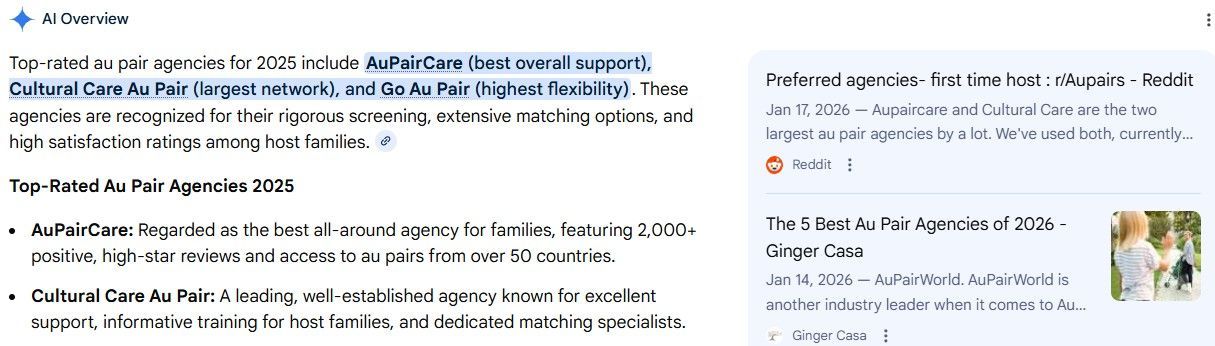
Example: One of our clients, Au Pair Care, was featured in a listicle that ranked the top 10 Au Pair Agencies in the United States. Following this ranking, they became the first recommended agency in the AI Overview, demonstrating the remarkable influence that a high-authority listicle can have on visibility and recommendations in today's AI-driven landscape.
By using descriptive titles in your bio links on social platforms and directories—like "Best Log Restoration" instead of just your company name—you tell the AI exactly what niche you own. This helps you become the "Category King" for that specific topic.
Phase 6. The Role of Transparency: Pricing, Location, and Trust Signals Such as Pricing, Phone Numbers and Contract Length.
Success Story: How PROSHRED Boosted Visibility with Transparent Pricing
Embracing transparency in pricing builds trust and is a powerful differentiator with AI. Many businesses hesitate to share their pricing publicly, yet doing so can make a substantial difference. For example, one of our clients, PROSHRED, saw a significant increase in AI-driven recommendations after we convinced them to clearly display their paper shredding fees online. Since pricing is a key factor users (and AI) consider when choosing a shredding service, this simple act of openness led to more frequent recommendations and increased customer inquiries each week. Embracing transparency in pricing not only builds trust with potential clients but also improves visibility and credibility in the eyes of AI systems.
Today's AI agents are not just looking at what you offer—they’re scrutinizing how transparent you are with essential business details. Including up-to-date pricing, location information, and award recognition can significantly boost your trust signals both with users and AI models.
- Pricing: Clearly listed and regularly updated service pricing shows you’re open and trustworthy, which AI agents interpret as a reliability signal.
- Location: Prominently display your address, service areas, and map integrations to reinforce your local authority—especially important for local queries.
- Awards and Recognition: Highlight third-party awards and industry accolades on your site. These are powerful trust markers and often get flagged by AI as credibility indicators.
Being open and direct with these variables doesn’t just inspire user trust—it also tells AI systems that your business is both authoritative and customer-focused, giving you a clear edge in the recommendation race.
Close The Loop
Consider the case of a regional HVAC service provider that had dominated traditional search for years but noticed a drop in AI-driven recommendations by platforms like ChatGPT and Gemini. After a thorough audit, it was clear the business suffered from a Recency Gap: its last major review spike was nearly two years old, schema markups were outdated, and digital chatter had faded across local forums. By focusing on updating their schema, publishing new testimonials and project photos, and engaging in fresh conversations on Reddit and industry sites, the business saw a significant rebound in AI-driven mention and recommendation rates within just three months. This "closed the loop" for AI verification—every claim was matched with an easily discoverable, verified proof, resulting in the business regaining visibility as a trusted choice in AI agent suggestions.
Looking Ahead: Future Trends in AI Optimization
AI’s role in marketing is only growing. Looking to 2027 and beyond, we expect AI agents to place even more emphasis on dynamic, user-generated content, real-time sentiment analysis, and deeper integration with voice and AR search platforms. Expect schema standards to evolve, with more granular metadata fields to describe service quality, environmental impact, and customer experience. Businesses that remain active participants in online communities, update their digital signals frequently, and invest in multimedia authority (think video reviews and interactive FAQs) will be best-positioned to dominate across tomorrow’s AI recommendation engines.

Common Pitfalls to Avoid
- Neglecting Off-Site Reputation: Relying only on your website is a critical error; AI agents actively scan social proof, reviews, and forum sentiment across the web.
- Outdated Technical Signals: Failing to update schema, sitemaps, or key business files (like llms.txt) can cause AI to overlook or misclassify your brand.
- Incomplete Local Signals: Overlooking detailed, accurate geo-pages or leaving out specifics like hours and parking can introduce friction, costing you recommendations.
- Ignoring Sentiment Shifts: Not monitoring or addressing negative trends in sentiment logs may result in lost trust and lower AI endorsements.
An Extra Nugget: The "Recency Gap" Data: "In 2026, data suggests that 68% of AI-generated recommendations prioritize businesses with verified digital activity within the last 90 days." Better get busy!
Conclusion: Bridging the Gap
The best AI Optimization strategy involves bridging the "Recency Gap" by combining technical signals (like llms.txt and Schema) with fresh sentiment logs. At ClickReady Marketing, we specialize in refreshing these signals through our AI decision optimization service so your long-standing business is recognized not just as a legacy player, but as a modern, trending authority.
Your customers are already using AI to find you. The question is: Is the AI recommending you, or your competitor?
FAQs
How often should I update my digital signals for optimal AI visibility?
It's best to refresh your on-site content, schema, and off-site citations at least every 6–12 months to maintain current signals and close the "Recency Gap."
What is the best AI brand audit strategy for 2026?
Combine technical optimization—like updated schema and llms.txt files—with active sentiment monitoring and curated authority signals on third-party platforms for a strong AI brand audit.
About the Author
Craig Lawson is the founder and CEO of ClickReady Marketing, an Atlanta-area SEO, PPC, and AI search optimization agency he launched in 2010 with co-founder Debbie. Before ClickReady, Craig spent years on the other side of the table, in B2B sales at G&K Services and JW Outfitters, running his own consulting firm, and building and selling two coffee shops and a retail business in North Georgia. That operator background shapes how he approaches marketing: leads and revenue over vanity metrics. Today ClickReady is a Google Premier Partner (top 3% of Google Partner agencies), a BBB A+ Accredited Business, and Georgia Business Journal's Best of Georgia digital marketing winner. Craig hosts ClickReady's Live SEO Sessions, where clients watch optimization work happen in real time.