What a Flock of Birds Taught Me About How AI and Google See Your Business
By Craig Lawson, Founder & CEO of ClickReady Marketing. Craig has led SEO and Google Ads campaigns for service businesses since 2010 and heads one of the top 3% of Google Partner agencies nationwide.

It started with chickens on a car roof.
Not mine — a neighbor's, down the road here in Dawsonville. Four hens holding a committee meeting on the roof of a shiny black SUV, claws and all. That paint job is toast. But standing there laughing, I realized I was looking at the same puzzle I work on every day: how AI and Google see your business is rarely how you see it. What looks like one thing to us can read as something completely different to a machine.
Then I went on a trip — Key West, Disney, a lot of birds — and the whole thing turned into the best marketing lesson I've stumbled into in years. Come along.
The Chickens That Fooled a Machine

Later that week, in a Key West gift shop, I found metal rooster sculptures. Welded feathers, painted combs, the works. And it hit me: a machine "recognizing" a rooster is only matching patterns — comb, wattle, tail. It'll happily label the welded one a rooster too.
That's how AI actually works. It recognizes patterns; it doesn't know truth.
Why This Matters for Your Business
When AI is confidently wrong, we call it a hallucination. Ask a chatbot about your company and it might invent hours you don't keep or a service you don't offer — stated with total confidence, like a metal rooster that looks alive.
The fix is unglamorous but real: give the machines accurate, consistent information everywhere they look, so they have less room to guess.
Two White Birds, One Big Difference

On a hotel path I met a great egret — tall, white, yellow bill, black feet. Its cousin, the snowy egret, is also tall and white, but it has a black bill and bright yellow feet. Birders call those "golden slippers." Miss that one detail and you've named the wrong bird.
Machines disambiguate businesses the same way. Two "Joe's Plumbing" listings in the same county get told apart by tiny signals: address, phone number, categories, the shape of the details.
Let your details go fuzzy, and Google can blur you together with a competitor — or credit your reviews to the wrong Joe. Getting your local SEO fundamentals clean is how you stay your own bird.
The Bird That Came With a Name Tag
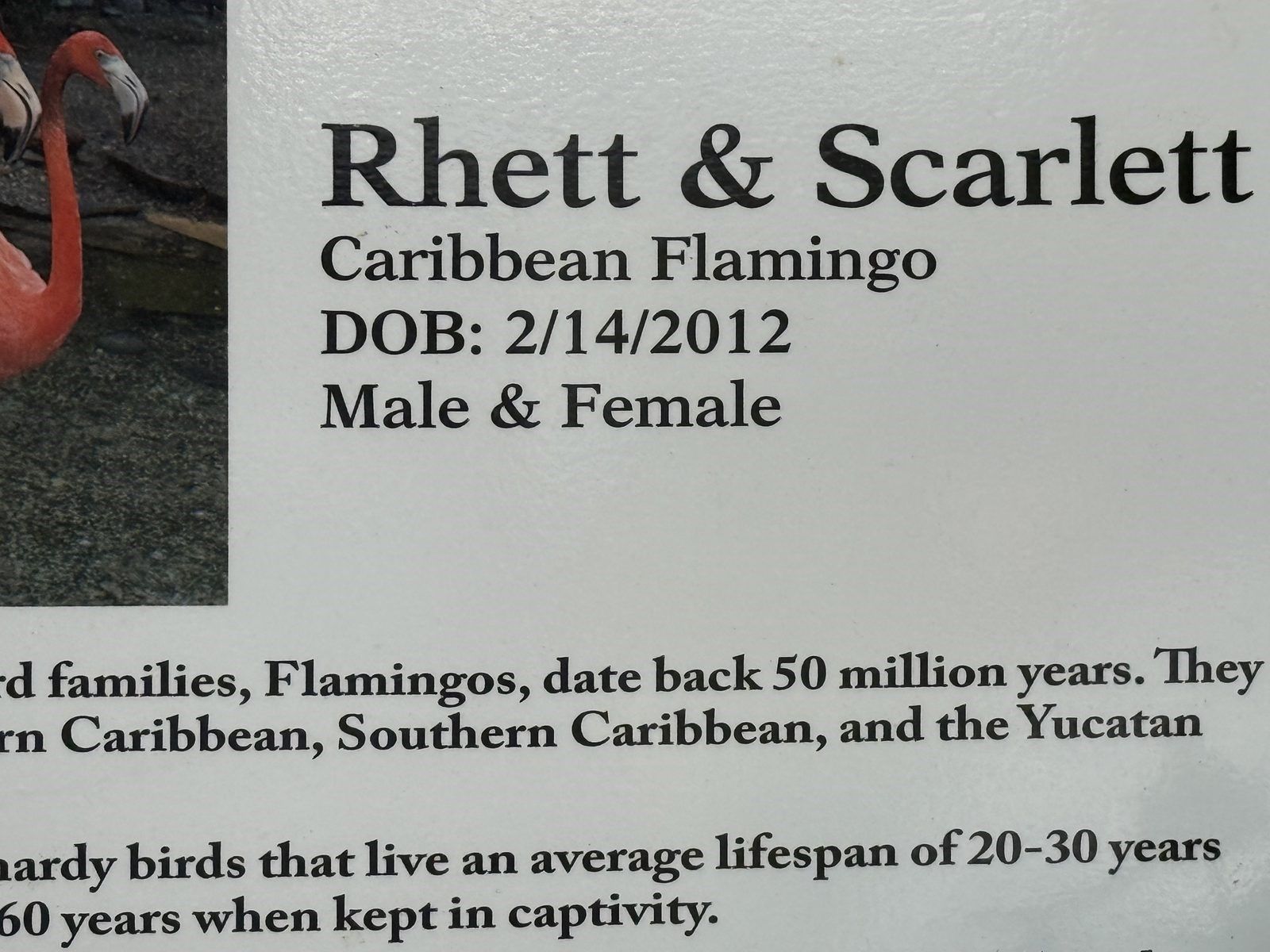
At the Key West Butterfly Conservatory, two Caribbean flamingos wade around a little stream. Next to them: a placard. Rhett & Scarlett. Caribbean Flamingo. DOB 2/14/2012. Male & Female.
I didn't have to know those birds. The sign told me everything, in plain, readable facts.
Here's the thing — a search engine never experiences your business. It reads the placard. Your Google Business Profile, your schema markup, your listings: that's your name tag. Fill it out completely and the machine repeats your facts accurately. Leave it blank and it's back to guessing, like a tourist squinting at an unlabeled cage.
Prime Perches and the Pecking Order

Off Higgs Beach, an old pier has collapsed into a line of barnacle-crusted pilings. Every piling had a bird — pelicans, cormorants, terns — and they were clearly ranked. Best perches up front, everyone else toward the back.
That's Google's local 3-pack. There are only so many prime spots on the map, and the birds that claimed them got there by being the best fit for that exact patch of water.
Same Water, Different Strategies
What I loved: the pelicans dive-bomb from above, the cormorants chase fish underwater, the terns pick off the surface. Same restaurant, three ways of ordering.
Your competitors are fishing the same water you are. Standing out isn't about being louder — it's about being unmistakably the right fit for what the searcher wants right now. That's the whole game behind showing up in local search.
You Rank What You Eat

Back to the flamingos. One was a deep, saturated orange; the other a washed-out pink. Same species, same pond. The difference is diet. Flamingos get their color from the shrimp and algae they eat. Stop feeding them the good stuff and the color fades.
Rankings work the same way. That vivid orange is earned daily: steady reviews, consistent listings, fresh content, real engagement. Skip the diet and you fade to pale pink while a better-fed competitor glows.
As a Dawsonville agency that's spent years doing one thing well for local service businesses, ClickReady Marketing tends to say it plainly to clients: you rank what you eat. There's no supplement that fakes it.
The Bird That Showed Up Live

One more. Back home, I keep a nest box with a camera. This spring the feed showed a little overlay: a running egg count, "Fourth Egg: April 11," updating as it happened.
That timestamp is a freshness signal. Google watches for the same thing, recent posts, current hours, updated photos, as proof you're active and open, not a listing someone abandoned three years ago. A business that keeps posting is a nest box with fresh eggs. One that went quiet looks empty, no matter how nice the box.
Don't Wing It

From a neighbor's ruined paint job to a turkey strutting across a Disney path like it paid admission, every bird on this trip was quietly showing me how AI and Google see your business: as patterns, name tags, prime perches, and diets — never quite the way we see ourselves.
The businesses that win aren't the loudest. They're the ones that fill out the placard, eat right, and keep showing up. If you'd rather not leave your visibility to guesswork, let's talk — we'll make sure the machines get your story right.
Birds of a Feather: Your Questions Answered
What's the best way to improve how AI and Google see your business?
Start with accuracy and consistency. Make sure your name, address, phone, hours, and services match everywhere online; your website, Google Business Profile, and major directories. Then keep it fed: steady reviews, fresh posts, and clear content. Machines reward businesses that are easy to read and obviously active.
Does AI search actually pull from my Google Business Profile and website?
Often, yes. AI tools lean heavily on structured, public information and your website plus Google Business Profile are among the most authoritative sources about you. If those are thin or contradictory, AI fills the gaps by guessing, which is how wrong hours and made-up services end up in answers. Complete, consistent details give it less room to invent.
About the Author
Craig Lawson is the founder and CEO of ClickReady Marketing, an Atlanta-area SEO, PPC, and AI search optimization agency he launched in 2010 with co-founder Debbie. Before ClickReady, Craig spent years on the other side of the table, in B2B sales at G&K Services and JW Outfitters, running his own consulting firm, and building and selling two coffee shops and a retail business in North Georgia. That operator background shapes how he approaches marketing: leads and revenue over vanity metrics. Today ClickReady is a Google Premier Partner (top 3% of Google Partner agencies), a BBB A+ Accredited Business, and Georgia Business Journal's Best of Georgia digital marketing winner. Craig hosts ClickReady's Live SEO Sessions, where clients watch optimization work happen in real time.