AI Mode Just Replaced Google Search. Here's Your Playbook.
By Craig Lawson, Founder & CEO of ClickReady Marketing. Craig has led SEO and Google Ads campaigns for service businesses since 2010 and heads one of the top 3% of Google Partner agencies nationwide.
Google made AI Mode the default on May 19, 2026. Here's what changed, why citation now beats ranking, and the 30/90/365-day plan for your business.

Google Just Rewrote Search. Here’s What It Actually Means for Your Marketing.
On May 19, 2026, Google announced the biggest change to its search bar in 25 years. AI Mode is now the default for nearly a billion users. Search agents work in the background without anyone typing a query. Personal Intelligence has gone live in 200 countries. And the way your customers find a shredding company, a law firm, an HVAC contractor, or a B2B service provider is no longer the way it worked six months ago.
This is not a small update. The version of SEO where "rank #1 and the calls follow" was already weakening. As of this week, it is officially over for any query Google decides to answer with AI. The good news: the businesses we work with at ClickReady can win on the new playing field, but only if they stop optimizing for the old one. Here is what changed, what it means for professional services, home services, legal, healthcare, and B2B, and the steps your business should take in the next 30 to 90 days.
What Google Actually Changed on May 19
Four announcements matter, and they all push in the same direction. Search is becoming less of a list of links and more of an answer engine that names a few trusted businesses and moves on.
1. AI Mode Replaces the Traditional Results Page
AI Mode now powers nearly one billion monthly users. It is a conversational interface, not a list of blue links. When your customer asks it a question, AI Mode either names your business as the answer or it does not. There is no "page two" to click to. There is no organic ranking below the summary. You are cited, or you are invisible.
2. The Search Box Now Accepts Almost Anything
Text, images, files, videos, even active Chrome tabs. Queries are getting longer and more conversational. Two-to-four-word keyword research is no longer enough. People are now asking things like "who is the most reliable on-site shredding company in Raleigh that handles HIPAA-regulated medical records" instead of "shredding company near me."
3. Information Agents Work in the Background
AI agents now scan the web continuously, on a user’s behalf, without that user typing anything. If your pricing is six months out of date, your hours are wrong, or your booking flow breaks on mobile, an agent may quietly skip your business and recommend a competitor. Your website now has a second audience: machines reading it before any human ever sees it.
4. Personal Intelligence Makes Every Result Different
AI Mode now connects to a user’s Gmail, Google Photos, and soon Calendar. Two people in the same neighborhood searching the same phrase will get different answers based on their inbox history and behavior. Uniform rankings no longer mean a uniform experience for your audience.
The Numbers Your Leadership Team Needs to See
We say this gently because it matters: if you are still benchmarking your traffic against 2024, you are reading the wrong scoreboard. Here is what large-scale research is showing in 2026:
- Position-one CTR has collapsed. On queries where AI features appear, click-through rate at position #1 has fallen from roughly 27% to as low as 11% (SISTRIX, March 2026).
- Most searches now end without a click. Zero-click searches account for 58.5% of all US Google searches (SparkToro and Datos).
- Citation beats ranking. Brands cited inside AI Overviews earn 35% more organic clicks and 91% more paid clicks than non-cited competitors on the same queries (Digital Applied, March 2026).
- A controlled study confirms the cause. A randomized field study published by Search Engine Journal in early 2026 found that AI Overviews cut outbound organic clicks by 38% on triggered queries.
Read that third bullet again. Being named inside the AI answer is now more commercially valuable than holding the top organic position below it. Citation is the new position one.
“The teams adjusting fastest right now are not panicking about traffic declines. They are pulling impression data, finding which queries trigger AI Overviews, and restructuring those pages to lead with a direct answer.” — Tanner Medina, Co-Founder, Launchcodex (industry commentary on Google I/O 2026)
AI Overviews vs. AI Mode — Why the Difference Matters for Your Strategy
These two features are often lumped together. They are not the same, and the difference shapes where you should invest.
Classic Search
How It Appears: Standard 10 blue links
Blue Links Shown?: Yes
What Wins Traffic: Position + ad spend
AI Overviews
How It Appears: AI summary above results
Blue Links Shown?: Yes, below the summary
What Wins Traffic: Being cited inside the AI answer
AI Mode
How It Appears: Full conversational interface
Blue Links Shown?: No
What Wins Traffic: Citation or no visibility at all
In AI Overviews, you can still earn traffic from organic positions below the summary, but at a much lower CTR. In AI Mode, there are no organic positions below the summary. You are either cited inside the conversational answer or you do not exist for that user, on that query, that day.
The "Fan-Out" Trick You Need to Know About
AI Mode now uses a process called fan-out. For a single user question, it issues up to 16 simultaneous sub-queries to gather information from multiple angles before answering. A search like "best shredding service for medical offices in North Carolina" may trigger separate lookups for HIPAA compliance, pricing, mobile vs. drop-off, service areas, and reviews — all in parallel.
The implication is significant for service businesses. A page can now surface inside AI Mode for queries it was never directly written for, as long as the content covers related subtopics with enough depth. A narrow page targeting a single keyword loses to a content cluster that covers the topic from multiple angles. This is why we have been pushing our clients toward topical depth rather than single-keyword pages for the last 18 months.
Will Local Search Still Work for Professional Service Businesses?
Yes. Arguably more than before. But the mechanics have shifted.
Local-intent queries (the kind a law firm, plumber, dentist, or shredding company depends on) still trigger fewer AI Overviews than informational queries. "Family law attorney in Cumming GA" or "mobile shredding company near me" still behave more like classic search than "what is paper shredding." But when AI does appear on a local query, it pulls data straight from your Google Business Profile and local content. That changes which levers you should be pulling.
1. Google Business Profile Is Now Infrastructure, Not Hygiene
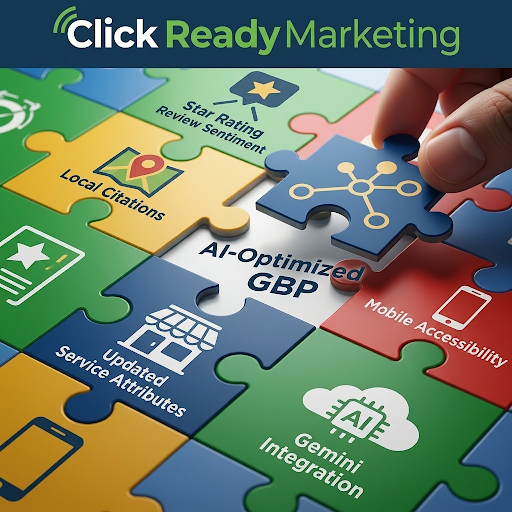
GBP feeds both Maps and the AI layer. Accurate hours, the right categories, service areas, real photos, steady review velocity, and quick response times now feed directly into AI Mode’s answers for local queries. For multi-location franchise clients like PROSHRED, that means location-level GBP discipline is no longer optional. One sloppy listing in one market can pull the brand out of AI recommendations in that market entirely.
2. Personal Intelligence Rewards Brands a Customer Has Already Touched
Because AI Mode now reads a user’s Gmail and Photos with their permission, a brand that already appears in their inbox (a quote, a confirmation, an email newsletter) or in their review history is more likely to be the brand AI surfaces back to them. Every email receipt, every review request, every directory listing, every appearance in a local press piece these now compound because they feed the personalization layer.
3. The Citation Pool Is Wider Than the Top 10
In mid-2025, about 76% of AI Overview citations came from pages ranked in the top 10. By early 2026, that overlap has fallen to somewhere between 17% and 54% depending on the study. Google’s AI is now pulling from Reddit, niche authority sites, industry publications, and structured data sources that may never appear in a standard top-10 result. Ranking optimization and citation optimization are now separate disciplines. You need to track and manage both.
Yes, Paid Ads Just Became More Important
Here is the data that should reshape your paid search thinking: cited brands earn 91% more paid clicks.
Organic citation and paid ads are no longer separate channels. They compound. When a user lands in AI Mode, asks follow-up questions, and sees your brand named in the AI answer, then sees your ad, then sees your organic listing, you convert at a dramatically higher rate than any one alone.
Three implications for paid search in 2026:
- Brand search defense gets more critical. When AI surfaces your brand, the very next thing a serious buyer does is search your name. If a competitor is bidding on it and you are not, you just paid (in citation effort) to send them a lead.
- Paid search is the only guaranteed visibility on high-intent commercial queries. "Mobile shredding cost," "criminal lawyer consultation," "HVAC repair near me" — these still show ads above everything else. As AI absorbs organic traffic, paid becomes the most reliable lane.
- Performance Max gets stronger if your feeds and structured data are clean. The same Merchant Center feeds, Local Service Ads data, and structured site data that feed AI Mode also feed PMax. Clients with disciplined data outperform clients without it.
A practical note for our service-business clients: this is why we now insist on CallRail across most accounts. Tracking pollution from multiple overlapping call platforms feeds bad data to Google’s smart bidding. With AI-influenced clicks costing more, you cannot afford to feed bidding signals that misattribute conversions.
Brand Awareness Just Became Non-Negotiable
Here is the unglamorous truth: to be cited by AI, the AI has to recognize your business as an entity worth citing. That recognition is built from a long list of unsexy work — consistent NAP across the web, schema markup, named experts on your team, third-party mentions in credible publications, real reviews on real platforms, authentic awards from legitimate programs (like Click360 Awards or Meritus Honors), and a brand that shows up in places AI trusts.
We have to be careful here, though. Google’s own May 2026 guide explicitly warns against chasing inauthentic brand mentions in forums, blogs, and social platforms. Their spam systems actively block manipulation, and seeding fake mentions carries real downside risk. The win comes from being genuinely cited, genuinely reviewed, and genuinely recognized by the institutions and communities your customers already trust.
A real-world example we like: one of our home care clients was being out-recommended by AI because a competitor displayed a dementia care certification on their site. Our client had the same certification but had never put it on the page. We added it. AI started recommending them. Small fix, huge win. That is the new game.
Your Action Plan: What to Do in the Next 30, 90, and 365 Days
A good response to this is tiered, not a panic rebuild. Here is the framework we are using across our client portfolio.
Tier: Protect
- Action: Audit GSC for queries where impressions rise but CTR falls. Rewrite those pages to answer the question in the first 100 words. (Next 30 days)
- Action: Clean every Google Business Profile: hours, categories, service area, photos, review responses. For multi-location brands, do this per location. (Next 30 days)
- Action: Consolidate conversion tracking. Multiple overlapping call platforms confuse bidding and waste budget on AI-influenced clicks. (Next 30 days)
Tier: Build
- Action: Add AI citation tracking to your reporting. Make "cited in AI" a KPI alongside rank and CPL. (Next 90 days)
- Action: Publish content only you can produce: case studies with named clients, local data, practitioner FAQs, certifications, awards. (Next 90 days)
- Action: Strengthen entity signals: schema (LocalBusiness, Service, FAQPage, Person), consistent NAP, named authors, third-party citations. (Next 6 months)
Tier: Future-Proof
- Action: Make your site agent-readable: no JavaScript-dependent pricing, hours, or service info. Keep transactional data current and structured. (Next 12 months)
- Action: Defend brand search with paid ads. Cited brands earn 91% more paid clicks. Brand + organic + AI citation is the new triple-win. (Ongoing)
Tier 1: Protect Existing Traffic (Next 30 Days)
- Pull Google Search Console data for your top 20 queries. Find every query where impressions are rising but clicks and CTR are falling. That gap is where AI Overviews are eating your traffic. These are the pages to rewrite first.
- Restructure those pages to answer the question in the first 100 words. AI systems pull from clear, direct answers near the top. Burying the answer in a 600-word intro is now a citation killer.
- Audit every Google Business Profile in your portfolio. Hours, categories, service areas, photos, response rates, primary category. For multi-location franchise clients, this is a per-location task.
- Reset your reporting baseline. Year-over-year traffic comparisons against 2024 are misleading. Add impression-share, AI citation appearance, and cost-per-booked-job to your monthly reporting.
Tier 2: Build Citation Authority (Next 90 Days to 6 Months)
- Add AI citation tracking to your reporting stack. Tools like SEMrush, Ahrefs, and BrightEdge now expose AI Overview appearance data. Treat "cited in AI" as a primary KPI alongside rank.
- Invest in content only your team can produce. Original case studies with named clients. Local data. Practitioner FAQs. Awards and certifications, visible on-page. AI systems cannot synthesize these from elsewhere, so they earn citation.
- Strengthen entity signals. Consistent NAP across the web. LocalBusiness, Service, FAQPage, and Person schema implemented correctly. Named author bios on content. Third-party citations in trusted publications.
- Shift from single-keyword pages to topical clusters. Because of AI Mode’s fan-out, one well-built cluster outperforms ten thin pages. Cover your topic from every angle a buyer might ask about.
Tier 3: Future-Proof for Agents and 2027 (Next 12 Months)
- Make your site agent-readable. If pricing, service area, hours, or availability requires JavaScript to render, AI agents may miss it. Run a DOM audit and fix the gaps.
- Keep transactional data current and machine-readable. Agents do not call you to ask. If your prices are stale or your booking flow is broken, they recommend a competitor.
- Defend your brand with paid ads. Brand + organic + AI citation is the new triple-win. Skipping any one of them leaves money on the table.
What to Stop Doing
We are seeing a lot of bad advice circulating. Some quick guardrails based on what Google has explicitly said:
- Do not chunk your content into tiny "AI-friendly" pieces. Danny Sullivan from Google confirmed in early 2026 that Google’s systems parse full pages and extract relevant passages on their own. Fragmenting your content does not help.
- Do not chase fake brand mentions in forums or comment threads. Google’s spam systems actively block manipulation, and the downside risk is real.
- Do not invent a separate "AI SEO" strategy. Google’s own May 2026 guidance is clear: AEO and GEO are not separate disciplines. They are foundational SEO applied to an AI surface. If your fundamentals are weak, no AI optimization layer fixes that.
- Do not benchmark against pre-AI traffic numbers. You will misread your results and reallocate budget away from what is actually working.
The Bottom Line
Ranking #1 used to be the goal. Now the goal is to be the brand Google’s AI names when it answers the question. For the professional service businesses we work with at ClickReady — law firms, B2B service providers, franchise operators, home services, healthcare practices — that shift demands tighter Google Business Profile discipline, more deliberate entity-building, cleaner conversion tracking, and paid ads as guaranteed visibility insurance.
The clients who win the next 12 months are not the ones chasing the latest "AI hack." They are the ones with clean fundamentals, distinctive content only they can produce, strong local presence across multiple touchpoints, and a partner who watches this stuff every day and adjusts their playbook accordingly.
That is exactly what we do. If you want to understand how your current marketing stands up to AI Mode, AI Overviews, and the new search box, we offer a complimentary AI Brand and Sentiment Audit that shows you what AI currently says about your business, how you compare to competitors, and where the citation gaps are. No pressure, no long-term contract.
Ready to see where you stand?
Call ClickReady at 404-850-8333 or visit www.clickready.com to schedule your complimentary AI Brand and Sentiment Audit. We will show you exactly which queries are losing traffic to AI, where you are being cited (and where you are not), and what to do about it in the next 30 days.
We are an A-Rated Accredited BBB Business, a Google Premier Partner (top 3%), a Click360 Best GEO Service Agency winner, and the 2024 and 2025 Georgia Business Journal Best Digital Marketing Firm.
Frequently Asked Questions
Will my Google rankings still matter after this update?
Yes, but differently. Strong organic ranking still earns eligibility to be cited inside AI Overviews and AI Mode. However, ranking #1 no longer guarantees the lion’s share of clicks on queries where AI summaries appear. Being cited inside the AI answer is now more valuable than ranking below it. You need both.
Does local SEO still work for service businesses?
Yes. Local-intent queries still trigger fewer AI Overviews than informational queries, and when AI does appear, it pulls directly from Google Business Profile and local content. GBP discipline, real reviews, accurate NAP, and consistent presence across local directories are more important than ever, not less.
Should I stop investing in SEO and move budget to paid ads?
No. The data shows the two compound. Brands cited in AI Overviews earn 91% more paid clicks than non-cited competitors. The win is to do both well, with clean tracking that shows you which channel drove which booked job.
What is the difference between AI Overviews and AI Mode?
AI Overviews appear at the top of a normal Google results page with blue links shown below them. AI Mode replaces the results page entirely with a conversational interface, with no blue links shown at all. In AI Overviews, you can still get clicks from organic positions below the summary. In AI Mode, you are cited or you are invisible.
Do I need a separate "AI SEO" strategy?
No. Google’s own May 2026 guidance confirms that AI optimization (AEO and GEO) is not a separate discipline — it is foundational SEO applied to a new surface. Clean technical SEO, distinctive expert content, strong entity signals, and accurate structured data are what earn citation. Anyone selling you a magic "AI SEO" service that bypasses fundamentals is selling you something we would not recommend.
How quickly will my business see results from these changes?
Tier 1 protective actions (GSC analysis, page rewrites, GBP cleanup, tracking consolidation) can show traffic stabilization within 30 to 60 days. Tier 2 citation authority work compounds over 3 to 6 months. Tier 3 agent-readiness pays off as agent traffic ramps through 2026 and 2027. The clients who started this work in late 2025 are already pulling ahead.
About the Author
Craig Lawson is the founder and CEO of ClickReady Marketing, an Atlanta-area SEO, PPC, and AI search optimization agency he launched in 2010 with co-founder Debbie. Before ClickReady, Craig spent years on the other side of the table, in B2B sales at G&K Services and JW Outfitters, running his own consulting firm, and building and selling two coffee shops and a retail business in North Georgia. That operator background shapes how he approaches marketing: leads and revenue over vanity metrics. Today ClickReady is a Google Premier Partner (top 3% of Google Partner agencies), a BBB A+ Accredited Business, and Georgia Business Journal's Best of Georgia digital marketing winner. Craig hosts ClickReady's Live SEO Sessions, where clients watch optimization work happen in real time.