The Invisible Friction: Why Traffic Isn't Enough
By Craig Lawson, Founder & CEO of ClickReady Marketing. Craig has led SEO and Google Ads campaigns for service businesses since 2010 and heads one of the top 3% of Google Partner agencies nationwide.
You can win the battle for traffic and still lose the war for revenue. In the service industry, the distance between a "click" and a "contract" is paved with anxiety. Every time a prospect lands on your site, they are silently asking: Is this company real? Are they good? Can I trust them in my home or with my business?
If you don't answer those questions immediately, they bounce. But trust isn't just for humans anymore. Search engines and AI recommendation engines are now programmed to "calculate" your credibility before they ever show your link to a user.
Layer 1: The Trust Stack (SEO & AI)
Algorithms and AI models don't have "gut feelings." They rely on Entity Validation—finding consistent, high-authority mentions of your business across the web to confirm your legitimacy.
- The "Notary" Effect: A backlink from the Better Business Bureau (BBB), a local Chamber of Commerce, or a major industry certification body acts as a digital seal of approval. It tells AI platforms that a third-party authority has verified you.
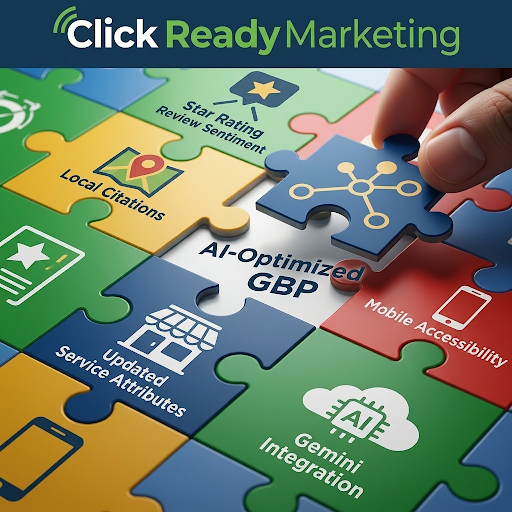
- The Review Constellation: AI doesn't just look at star ratings; it performs Sentiment Analysis. It looks for specific, descriptive phrases in reviews (e.g., "transparent pricing," "arrived on time") to categorize your reputation.
- Data Consistency: If your address is different on your Google Business Profile than it is on your website, you create "data friction." AI models prioritize the most "certain" entities; inconsistency looks like a risk.
Layer 2: The Psychology of the Page (PPC & UX)
When you pay for a click via PPC, a lack of trust is a direct tax on your ROI. You must lower the visitor's "anxiety meter" using visual cues and strategic placement.
- The Power of the Face: Stock photos are "trust killers." Using high-quality photos of the actual owner or service team reduces "stranger danger." Service businesses are built on human relationships; show the humans. 📸
- Proximity of Evidence: Don't hide your testimonials on a buried "Reviews" page. Place a specific, relevant testimonial exactly where the friction is highest—right next to your contact form.
- The Anatomy of a High-Trust Testimonial: A great testimonial handles an objection. Instead of "They were great," look for: "I was worried about the cost, but the quote was exact and the work was flawless."
Pro Tip: Use "Face-to-Form" alignment. Position a photo of a smiling team member so their eyes are looking toward your lead capture form. It’s a subtle psychological cue that directs the visitor's attention to the goal.
The Anxiety Audit: Solving for Friction
Before you spend another dollar on ads, walk through this audit to find where you are losing leads to "the fear factor."
| Friction Point (The Fear) | The Trust Fix (The Proof) | How it Works |
|---|---|---|
| "Is this a real company?" | Live Action Photography | Use photos of your actual team, office, and branded trucks. |
| "Are they actually good?" | Verification Badges | Display logos from the BBB, Google, and industry certifications. |
| "Will they rip me off?" | Transparent Process | Outline a simple 3-step "How it Works" section. |
| "Can I trust them in my home?" | Safety Seals | Use "Technician Safety" badges or mention background checks. |
The Principle of Cumulative Proof: The more expensive or personal the service, the more trust signals you must provide before the visitor will take action.
The Future: AI Recommendation and "Technical Trust"
We are moving into an era of Generative Engine Optimization (GEO). AI platforms like Perplexity and Gemini prioritize "quotability."
- Schema Markup: Use this "behind-the-scenes" code to label your reviews and credentials so AI can "read" your authority.
- Entity Clarity: Ensure your founder’s name, business start date, and service area are identical across LinkedIn, the BBB, and your site.
Strategic Takeaway
Trust is not a "soft" metric; it is a technical asset. By aligning your off-site authority (backlinks/reviews) with your on-site psychology (faces/proximity), you create a "Trust Stack" that satisfies both the algorithm and the human.
The brands that invest in verified proof today will be the ones AI recommends tomorrow.
| Question | Answer |
|---|---|
| What is the best trust signal for a local service business? | High-quality, authentic photos of your actual team and branded vehicles are the most effective way to immediately reduce buyer anxiety. While reviews are vital for SEO, visual humanity is the strongest lever for on-page conversion. |
| Does the BBB really help with SEO? | Yes, because it serves as a high-authority "entity validator" that confirms your business's legitimacy to search engines. A link from the BBB is a powerful signal of E-E-A-T (Experience, Expertise, Authoritativeness, and Trustworthiness). |
| How do AI platforms "read" my reviews? | AI models use natural language processing to identify themes and sentiment within your text-based reviews. They look for specific attributes like "reliability" or "professionalism" to decide if they should recommend you for specific queries. |
About the Author
Craig Lawson is the founder and CEO of ClickReady Marketing, an Atlanta-area SEO, PPC, and AI search optimization agency he launched in 2010 with co-founder Debbie. Before ClickReady, Craig spent years on the other side of the table, in B2B sales at G&K Services and JW Outfitters, running his own consulting firm, and building and selling two coffee shops and a retail business in North Georgia. That operator background shapes how he approaches marketing: leads and revenue over vanity metrics. Today ClickReady is a Google Premier Partner (top 3% of Google Partner agencies), a BBB A+ Accredited Business, and Georgia Business Journal's Best of Georgia digital marketing winner. Craig hosts ClickReady's Live SEO Sessions, where clients watch optimization work happen in real time.